Informe Pacheco
Los pacientes del doctor GarcíaThe Informe Pacheco is Manuel Arroyo Benítez’s painstaking dossier on Nazi fugitives and the people and institutions that helped them escape. Its more than four hundred typewritten pages and nearly one hundred photographs gather names, addresses, dates, crimes, and travel routes into evidence that could have supported arrests in Madrid and Buenos Aires. But the report’s most consequential history is also one of frustration: its findings were praised, yet no effective action followed, and Manuel kept a copy for decades, unsure whether preserving it could still serve justice or only endanger his family.
Creation and Scope
Manuel wrote the document in Buenos Aires while investigating the escape and assistance networks that connected Spain with Argentina. The report’s title came from Fred Goodwin at the United States embassy, who called it the Informe Pacheco, using Manuel’s assumed identity. When Manuel later gave the file to Guillermo García Medina, he explained that its first section covered material Guillermo already knew, with additional discoveries, while the account of Argentina began around page two hundred.
The physical dossier was substantial: more than four hundred single-spaced typescript pages and nearly a hundred photographs. The images showed building fronts and interiors, documents, and people. The written material assembled authentic and false names, private and professional addresses, dates, locations, sea and air routes, and even the flight number on which Manuel himself had arrived. Its scale made the report more than a collection of suspicions: it was an organized attempt to connect individuals, aliases, places, and movements across borders.
Among the people named were Clarita Stauffer, Ingrid Weiss, Eberhard Messerschmidt, Hans Lazar, Johannes Bernhardt, Ante Pavelić, Walter Kutschmann, Jean-Jules Lecomte, Louis Darquier de Pellepoix, Léon Degrelle, and Otto Skorzeny. The report also identified people who had attended Manuel’s Spanish lessons, including two Croatian conversation partners, a man from Munich, and a Hungarian. That reach reflects the way the inquiry moved from the visible work of escape assistance toward the networks of contact surrounding it.
Evidence and the Escape Network
The report’s findings grew out of Manuel’s infiltration of Stauffer’s circle. After beginning work connected to the organization, he spent time at Galileo 14, helped the office staff with errands, and used his growing access to learn about its routine. During his holiday shift, beginning on 15 June, he became almost an additional secretary. This position gave him opportunities to observe the operation and write down what he learned at night.
His earlier account of the house had already supplied clues about the network’s methods. In the summer of 1945, Stauffer turned rooms into an office, installed a new telephone line, hired secretaries, and filled new wardrobes with men’s clothing and shoes in a range of sizes. Thin, tired visitors arrived; they received food and clothes but did not sleep at the house. Some appeared to return to the office after leaving. A baptismal certificate bearing German names and a 1907 date, obtained through a parish connection, pointed toward the provision of Spanish documentation. The later report’s lists of identities and addresses gave these observations a broader investigative frame.
Manuel and his collaborators believed the network cooperated with the Perón government and helped fugitives reach Argentina. Their working theory was that Spanish baptismal records and contacts in the state administration could help supply Spanish papers, while the route south offered a destination for people seeking to avoid international tribunals. They also understood that the evidence had to be verified: an informant’s account alone could not establish who particular visitors were or prove the full extent of Stauffer’s activity. The report’s significance lies partly in its effort to turn scattered clues into a documented network, while the limits of what could be proved remained important.
Delivery, Inaction, and Preservation
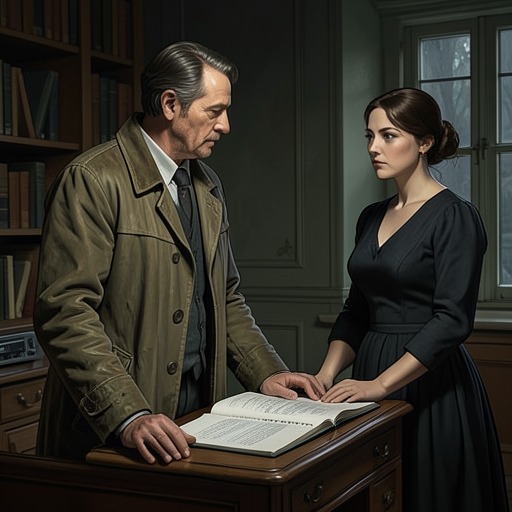
When Manuel handed over the folder, it was in a blue ring binder so full of papers that its covers opened at an angle. He described what the information could have enabled: if authorities had chosen to act, he said, they could have gone to the listed addresses and arrested a hundred war criminals in Madrid and Buenos Aires in a single night. His claim gives the dossier a stark practical measure: the report did not merely identify a historical problem; it contained leads that could have been pursued against named people.
The response, as Manuel recounted it, was praise without the arrests he believed the information could support. He said the recipients had lauded his work, and that the CIA even tried to recruit him. He refused. At first he feared that keeping a copy might have been a mistake, but the thought of the original being destroyed in a Washington office troubled him more. He did not send his copy to Pablo de Azcárate, and instead installed a safe in a wall of his home after marrying Simona. The report remained there for years.
The political circumstances of Argentina shaped his decision to preserve it. After Juan Perón fell in 1955, Manuel was glad he had not destroyed the dossier, because Nazis in Argentina were no longer as well protected. Even so, he had become a husband and father, and he feared that publishing the material could expose him: the people he had investigated knew him and might find him. He considered sending the report to Simon Wiesenthal or another Nazi hunter, but judged that making it public could still put him and his family at risk.
What the Document Records—and What It Cannot Repair
As Guillermo turned the pages, the report’s names and dates sat beside records of mass murder and deportation across a long list of camps, including Dachau, Gusen, Birkenau, Jasenovac, Mauthausen, Auschwitz, and Klooga. It also recorded the crime of Adrián Gallardo, the man Guillermo had killed to save himself and Manuel. For Manuel, Gallardo’s presence in the file reduced a private trauma to one entry among many; for Guillermo, reading it reopened a memory that continued to trouble him.
Manuel explained why he had not pursued publication. He doubted that arrests made because of his work would change anything in Spain under Franco, and he felt that the Allies had failed to act for the Spanish Republicans. His withdrawal from the cause was not a claim that the crimes in the report did not matter. Rather, he described a collapse of faith in the prospect that exposing them would produce justice, alongside fear for the family life he had built. The file preserved evidence, but it could not compel the authorities who possessed the power to use it.
The scene of its transfer therefore gives the Informe Pacheco two intertwined meanings. It is an unusually detailed record of a clandestine escape system, assembled from access, observation, names, documents, and photographs. It is also the material form of Manuel’s unresolved choice: whether to risk his family’s safety and renew a campaign that had already been ignored, or keep the evidence safe while accepting that preservation alone might not bring the guilty to account.